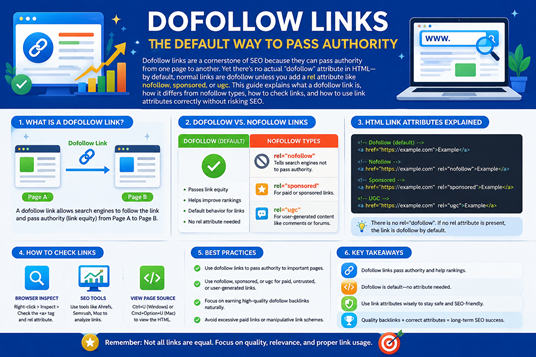
Dofollow links are a cornerstone of SEO because they can pass authority from one page to another. Yet there’s no actual "dofollow” attribute in HTML—by default, normal links are dofollow unless you add a rel attribute like nofollow, sponsored, or ugc. This guide explains what a dofollow link is, how it differs from nofollow types, how to check links, and how to use link attributes correctly without risking SEO.
What is a dofollow link?
A dofollow link is a standard hyperlink that search engines can crawl and consider for passing ranking signals (often called "link equity”or "link juice”). There is no rel="dofollow"—the absence of restrictive attributes makes the link dofollow by default.
Dofollow vs. nofollow, sponsored, and UGC
Not every link should pass equity. The rel attribute lets you qualify links based on how they were placed. Use the right signal for transparency and to reduce spam signals.
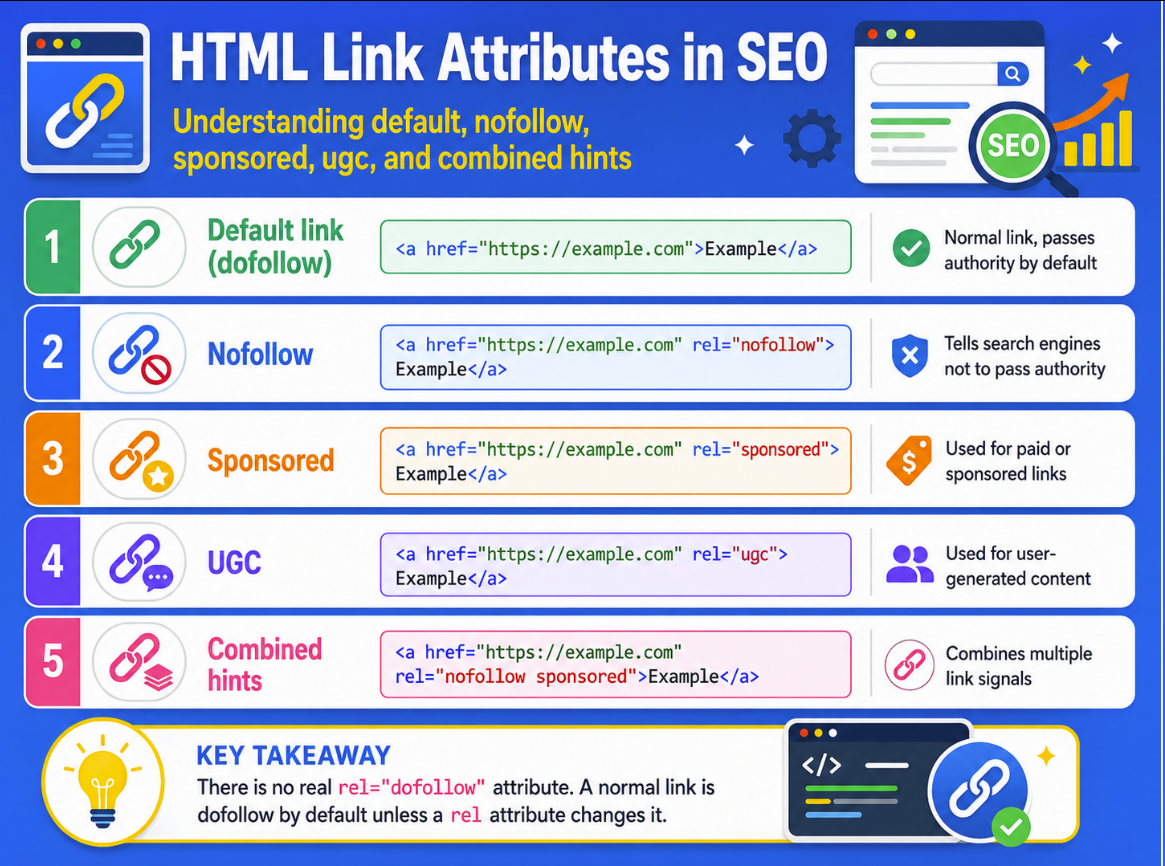
Dofollow (default)
Use when you editorially endorse a page and want search engines to consider the link as a signal. Examples: citing a source in an article, linking to a partner’s study you genuinely recommend, or linking to your own internal pages.
rel="nofollow"
Use when you don’t want to explicitly endorse the target or when links are untrusted. Common cases:
Unvetted external links in comments or forums (if not using
ugcspecifically)Widgets or auto-generated links
Situations where you’re unsure of link quality
Search engines treat nofollow as a hint, not a guarantee, but it’s the right signal when you aren’t vouching for the target.
rel="sponsored"
Use for paid links, affiliate links, or any compensation-driven placements. This signals that the link is an advertisement or sponsorship and should not pass normal editorial endorsement.
rel="ugc"
Use for user-generated content like comment sections or forum posts. This helps separate editorial links from those created by users, reducing spam signals.
How to check if a link is dofollow
You can confirm a link’s status in seconds. Here’s a quick checklist and methods to verify.
Quick checklist: Is there a
relattribute? If it’s missing (and no page-level nofollow), it’s dofollow. Ifrelcontainsnofollow,sponsored, orugc, it’s not dofollow.Browser DevTools: Right-click the link, Inspect, and check the
tag forreland the surrounding HTML.View Source: Use your browser’s "View Source” and search for the anchor; confirm the
relvalue.Extensions: SEO toolbars and link highlighters can color-code nofollow vs. dofollow links for quick scanning.
Page-level signals: Check for
or an equivalent directive. That can turn all page links into nofollow for crawlers.JavaScript/redirects: If links are inserted via scripts or redirect through interstitials, verify the final rendered DOM and how bots might see it.
Why do dofollow backlinks matter for SEO?
Dofollow backlinks are one of many signals that help search engines evaluate the authority and relevance of a page. Quality matters more than quantity. Here’s why they’re valuable—and what really makes them count.
Authority transfer: Editorial dofollow links from trusted pages can pass signals that help your pages rank. Think of it as a recommendation seen by search engines.
Context and anchor text: Links surrounded by relevant content and descriptive anchor text help clarify what your page is about, improving discoverability for related queries.
Placement: Links in the main body content, within context, tend to carry more weight than boilerplate footer or sidebar links because they align with the page’s primary topic.
Diversity and natural patterns: A healthy link profile includes both dofollow and nofollow links, from a range of domains, with varied anchors. Over-optimized patterns can look unnatural.
Dofollow links don’t guarantee rankings, but they remain a practical way to build visibility when earned from reputable, relevant sources.
How to earn dofollow backlinks (safely)
Focus on relevance, usefulness, and credibility. Avoid shortcuts that risk penalties or wasted effort.
Create reference-worthy assets: Publish original research, step-by-step guides, calculators, or downloadable templates. People link to content that solves specific problems.
Digital PR and outreach: Pitch unique data or angles to journalists and niche blogs. A clear story and credible sources increase coverage potential.
Resource page and list inclusion: Identify pages that curate tools or guides in your niche. Offer a concise value statement and a reason your resource deserves inclusion.
Broken-link building: Find dead links on relevant pages, create or map a replacement resource, and suggest your page as a fix. You help the site owner, they help you.
Guest contributions (editorial-first): If allowed, contribute genuinely valuable articles to reputable sites. Avoid mass guest posting. Disclose any compensation and be comfortable if a link is marked
nofolloworsponsored.Community-driven visibility: Participate in expert roundups, podcasts, and webinars. Even if links are nofollow, exposure can lead to future dofollow mentions.
Best practices for using link attributes
Use rel values consistently and for the right reasons. Here’s a practical framework:
Editorial endorsements: If you vouch for a page and the link is naturally placed, keep it dofollow (no restrictive
rel).Paid or compensated links: Add
rel="sponsored". You can combine withnofollowif desired:.User-generated content: Add
rel="ugc"(and optionallynofollow) to comment and forum links. This helps separate editorial content from user submissions.Untrusted or unvetted links: Use
rel="nofollow"to avoid passing endorsement signals while still allowing users to click.Avoid nofollow for internal navigation: Internal links are dofollow by default and help distribute authority and aid discovery. If you don’t want a page indexed, use canonical tags, robots directives, or technical controls—not internal
nofollow.Affiliate and tracking URLs: Mark these as
sponsored(and oftennofollow) to be transparent about their nature.
Conclusion
Dofollow links are the default link type, so you do not need to activate them—just avoid adding restrictive rel attributes unless necessary. Use nofollow for untrusted links, sponsored for paid or affiliate links, and ugc for user-generated content. To earn valuable dofollow backlinks, focus on creating useful resources that others naturally want to cite, supported by ethical outreach. Regularly audit your website’s links, especially on important pages, to make sure internal links remain dofollow, commercial links are labeled correctly, and trusted editorial links are not accidentally blocked with unnecessary nofollow tags.
FAQS
What is a dofollow backlink?
A dofollow backlink is an external link that doesn’t include restrictive rel attributes like nofollow, ugc, or sponsored. It can pass authority signals from the linking page to the target page.
Are dofollow links still important?
Yes—within a balanced strategy. High-quality, relevant dofollow links help search engines evaluate your site’s authority. However, content quality, user experience, and technical SEO are equally important.
Do internal links pass authority?
Yes. Internal links are dofollow by default and help distribute authority and clarify site structure. Use descriptive anchor text and link to your most important pages from related content.
Is "follow” the same as "dofollow”?
In practice, yes—people use "follow” and "dofollow” to mean the default state of a link. There is no rel="dofollow" attribute; the link is dofollow if you do not add restrictive rel values.
Should I add rel="dofollow" to force it?
No. rel="dofollow" is ignored. To make a link dofollow, simply leave off restrictive attributes like nofollow, sponsored, and ugc.
Can a nofollow link still drive value?
Absolutely. Nofollow links can send referral traffic and build brand visibility. They may also indirectly lead to dofollow coverage when people discover and cite your content elsewhere.